Last year, holiday sales topped $1 trillion for the first time, up 4.1%, according to …



Cloud-native POS platform for seamless omnichannel customer experience.

A single hub for all promotions campaigns.

A comprehensive solution designed to simplify and give you ownership of the inventory lifecycle.

A native post-transaction reconciliation module built into Jumpmind Commerce.

The most advanced synchronization solution for databases and file systems.

Data configuration and batch automation across different disparate systems and vendors.
Last year, holiday sales topped $1 trillion for the first time, up 4.1%, according to …

The store is becoming a relationship, not just a transaction The store is being talked …

I spent this week at eTail Boston, and if you looked at the agenda, you’d …
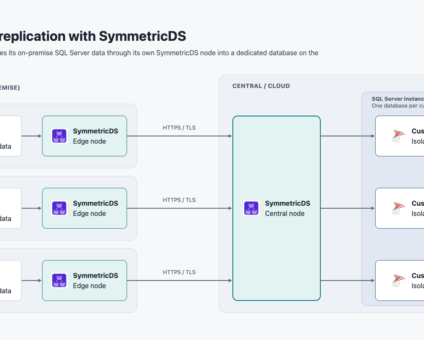
Learn how to replicate each tenant database in a central SQL Server to its own edge database with SymmetricDS. One routing rule and a matching external ID keep tenants isolated.

Quick answer: Agentic AI systems need data that is current, consistent across systems, available even …
This was our second year at Big Data LDN, and attendance felt just as strong …

Introduction In retail, POS updates have traditionally been quarterly events at best. From October through …

Jumpmind Powers Point of Sale and Promotions Execution for Landmark Retail, One of the Largest …

Retail Technology Leader Jumpmind to Enable Mobile Point of Sale and Inventory Management for DTLR/VILLA …
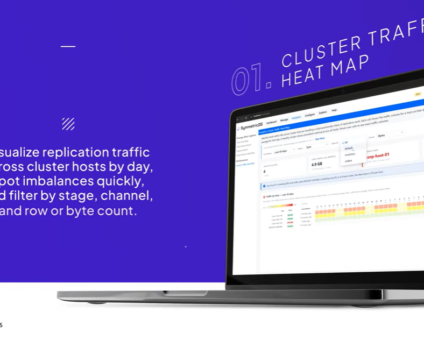
We built 3.18 because the question we kept hearing from customers changed. It used to …

The offering gives security teams a practical path to risk management and accountable AI COLUMBUS …

The insights have implications for retail technology in the store: it must help mind information …
Cloud-native POS platform for seamless omnichannel customer experience.
A single hub for all promotions campaigns.
A comprehensive solution designed to simplify and give you ownership of the inventory lifecycle.
A native post-transaction reconciliation module built into Jumpmind Commerce.
The most advanced synchronization solution for databases and file systems.
Data configuration and batch automation across different disparate systems and vendors.
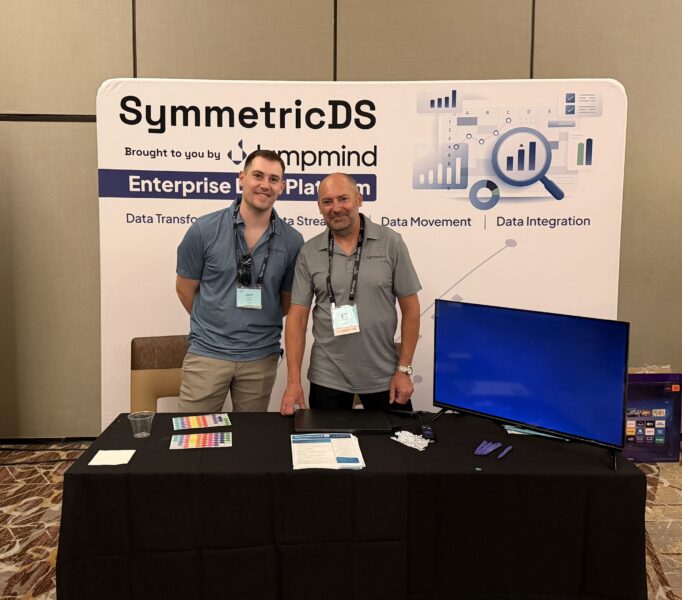
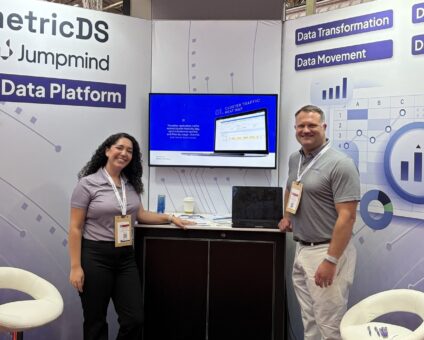
Our booth at TDWI Transform this year had a wider range of visitors than we expected, and they weren’t all there for the same reason. Small teams testing the waters stood next to people from large enterprises already deep into infrastructure decisions. Some were mainly there to get oriented to AI and BI, many still just getting a handle on the new agentic landscape. Some had a specific problem already in hand and wanted ideas for solving it. And some weren’t sure where to start at all, in a few cases because they’d inherited a mess.
Three different starting points, but the conversations converged into two threads, not as separate as you’d think.
For the AI-curious, the conversation rarely stayed on AI for long. It moved quickly to BI and reporting, and specifically to a complaint we heard again and again: dashboards that quietly stopped matching what was actually happening in the source systems. Nobody was asking how to get data into their reporting tool. They were asking why the numbers already there couldn’t be trusted.
For the rest, the conversation centered on compliance and migration, though people arrived at it from different places. Some already knew exactly what was broken and wanted ideas for fixing it. Others weren’t sure where to even start, in a few cases because they’d inherited the mess in the first place. Regulation wasn’t a footnote for this group, it was often the first constraint they mentioned, shaping what they were even allowed to do with their data before cost or performance entered the picture. And several described concrete plans already underway to move off older database platforms and onto modern data warehouses and data lakes.
One conversation stuck with us in particular: a public sector team talking through the work of moving a citizen-facing process off paper entirely. It was a good reminder that for some organizations, “modernizing data infrastructure” isn’t about AI or advanced analytics. It’s about replacing a manual, paper-based process with anything digital at all.
Everyone we talked to naturally saw the problem through the lens of their own role, though a few were already thinking about it more holistically, beyond their own team or department. Different starting points, same booth, and a common thread underneath every conversation: whatever people came to TDWI looking for, what actually stood in their way was rarely the tool in front of them. It was the data plumbing behind it, whether that meant a sync nobody trusted, a compliance rule nobody could route around, or a migration nobody had started yet.
If any of that sounds familiar, it’s the exact problem SymmetricDS is built to solve. Take a look at what it can do for your data or get in touch if you want to talk through your setup.