Last year, holiday sales topped $1 trillion for the first time, up 4.1%, according to …



Cloud-native POS platform for seamless omnichannel customer experience.

A single hub for all promotions campaigns.

A comprehensive solution designed to simplify and give you ownership of the inventory lifecycle.

A native post-transaction reconciliation module built into Jumpmind Commerce.

The most advanced synchronization solution for databases and file systems.

Data configuration and batch automation across different disparate systems and vendors.
Last year, holiday sales topped $1 trillion for the first time, up 4.1%, according to …

The store is becoming a relationship, not just a transaction The store is being talked …

I spent this week at eTail Boston, and if you looked at the agenda, you’d …
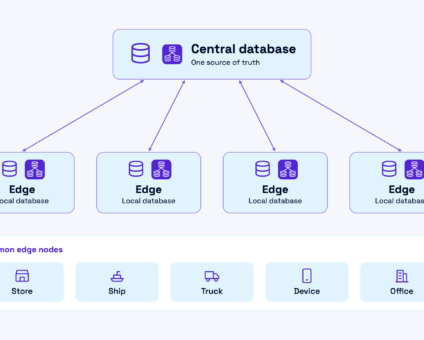
SymmetricDS’s most common deployment pattern: one central database syncing with thousands of edges, using composite keys and routers to prevent collisions and control data flow.
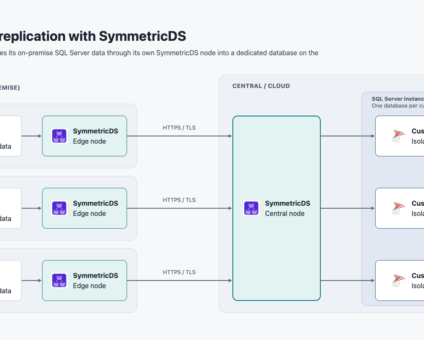
Learn how to replicate each tenant database in a central SQL Server to its own edge database with SymmetricDS. One routing rule and a matching external ID keep tenants isolated.

Quick answer: Agentic AI systems need data that is current, consistent across systems, available even …

Short answer: Alpha Ori Technologies is a maritime ERP provider that became part of …

Introduction In retail, POS updates have traditionally been quarterly events at best. From October through …

Jumpmind Powers Point of Sale and Promotions Execution for Landmark Retail, One of the Largest …
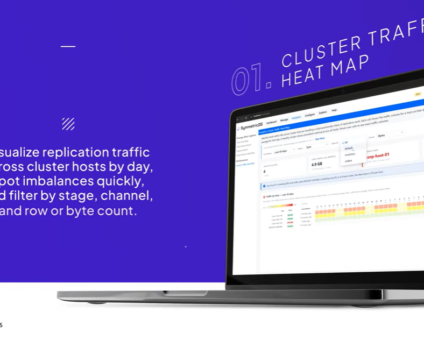
We built 3.18 because the question we kept hearing from customers changed. It used to …

The offering gives security teams a practical path to risk management and accountable AI COLUMBUS …

The insights have implications for retail technology in the store: it must help mind information …
Cloud-native POS platform for seamless omnichannel customer experience.
A single hub for all promotions campaigns.
A comprehensive solution designed to simplify and give you ownership of the inventory lifecycle.
A native post-transaction reconciliation module built into Jumpmind Commerce.
The most advanced synchronization solution for databases and file systems.
Data configuration and batch automation across different disparate systems and vendors.

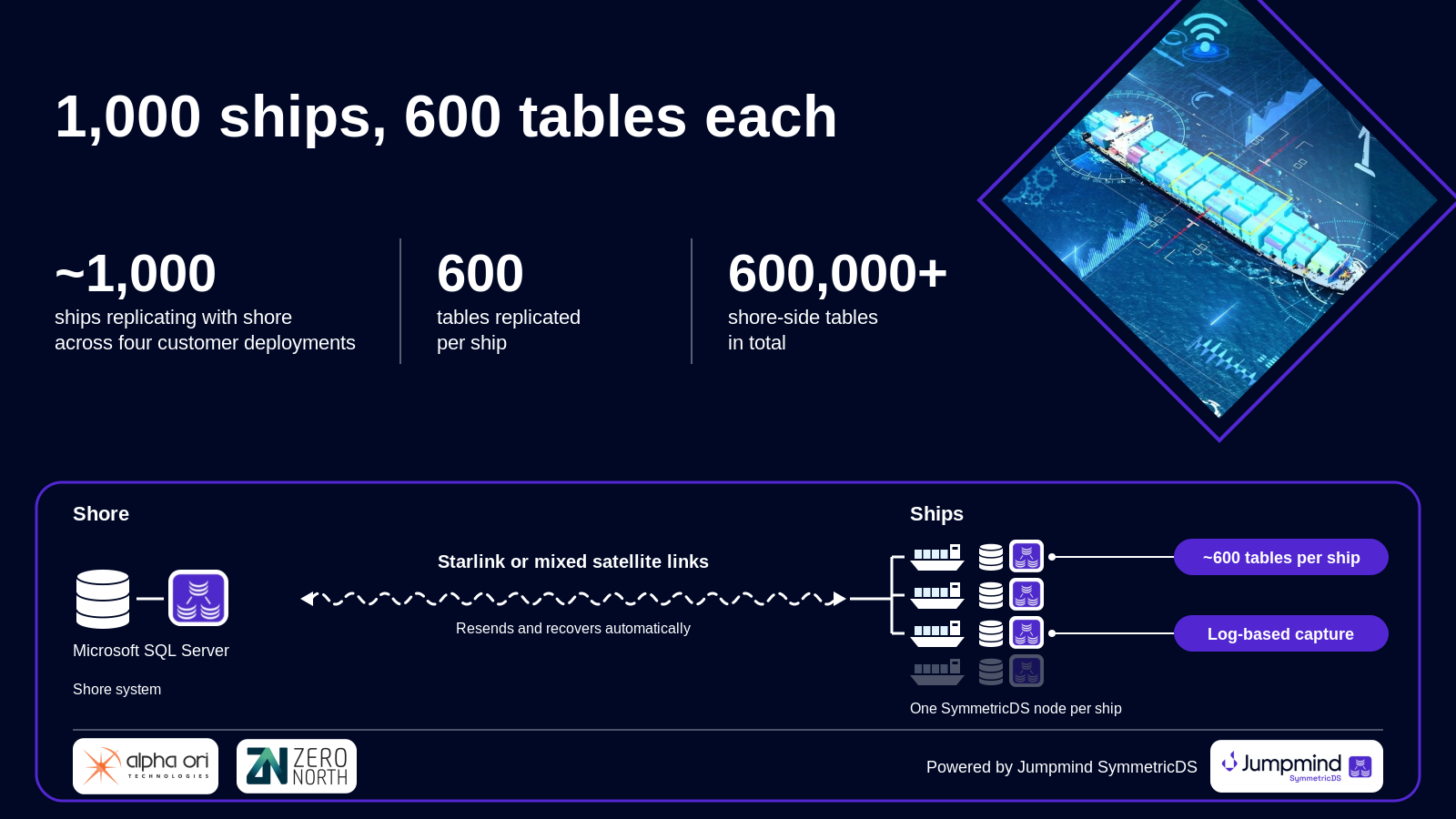
Short answer: Alpha Ori Technologies is a maritime ERP provider that became part of ZeroNorth in 2024. It uses Jumpmind SymmetricDS for ship-to-shore data replication, keeping Microsoft SQL Server in sync between shore systems and roughly 1,000 ships across four customer deployments. Each ship-to-shore pair uses about 600 tables. As a result, SymmetricDS keeps shore and ship in sync even over inconsistent satellite connectivity, resending and recovering automatically when links drop.
Key takeaways:
At a glance
Company: Alpha Ori Technologies, maritime ERP software, part of ZeroNorth (Copenhagen) since 2024
Industry: Maritime software
Database: Microsoft SQL Server, shore and ship
Deployment: Shore-to-ship replication, one SymmetricDS node per ship
Scale: About 1,000 ships across four customer deployments, roughly 600 tables per ship
Capture method: Log-based capture since 2026



Alpha Ori Technologies builds ERP software for the maritime industry, running aboard ships and ashore for fleet operators around the world. In 2024, Alpha Ori became part of ZeroNorth, a Copenhagen-based group focused on maritime software. Every ship in an Alpha Ori deployment runs its own local SQL Server database, kept in sync with a shore-side system that ERP, operations, and shore staff rely on. For example, Alpha Ori’s two largest customer deployments cover 470 and 505 ships respectively, while two additional customers run smaller deployments of about 25 ships each.
Each ship-to-shore pair in an Alpha Ori deployment includes about 600 tables. Shore-side table names include the ship’s name, so every ship’s data stays isolated from every other ship’s. That means every ship added to a fleet adds roughly 600 more tables on the shore side. At Alpha Ori’s largest customer, that works out to somewhere between 282,000 and 303,000 shore-side tables.
Meanwhile, connectivity between ship and shore is inconsistent. Ships connect over Starlink and other satellite links that can drop out or degrade without warning. So replication has to tolerate interruptions and resend or recover automatically once connectivity returns.
Alpha Ori needed a single replication engine that could run the same way across every ship. It had to work without custom code inside the ERP itself, and it had to resend and recover automatically over links that aren’t always reliable.
Jumpmind SymmetricDS handles ship-to-shore data replication by running between each ship’s local SQL Server and the shore-side SQL Server, with one SymmetricDS node per ship. Every deployment replicates the same roughly 600 tables.
When a ship’s connection drops or degrades, SymmetricDS queues changes. It resends them automatically once the link is back, without manual intervention.
Including the ship’s name in shore-side table names isolates each ship’s data from every other ship’s, even as the shore-side table count grows into the hundreds of thousands.
In 2026, Alpha Ori moved from trigger-based to log-based capture. This removed triggers across hundreds of thousands of database objects.
Jumpmind added wildcard table support to SymmetricDS, so Alpha Ori’s roughly 600-table configuration scales to each new ship without defining every table individually. In addition, Jumpmind’s support team worked with Alpha Ori on tuning worker thread scaling, database connection pooling, and the volume of data sent over satellite links. For more on how SymmetricDS routers can filter and scale replication like this, see our guide on subsetting data during replication.
Alpha Ori now runs SymmetricDS across roughly 1,000 ships in four customer deployments, replicating about 600 tables per ship between shore and ship SQL Server databases. In 2026, the company completed its move to log-based capture, removing triggers across hundreds of thousands of database objects.